Decode the traps before they bite
Exclusions are the “we don’t pay for that” section. Pair this checklist with our Understanding Your Policy pillar guide and highlight the page numbers that apply to you.
Your policy is a list of “we cover this” and “we don’t cover that.” The “don’t cover” list lives in exclusions. When a claim hits an exclusion, the insurer can legally say no—even if you have photos, receipts, and police reports. This guide shows the top exclusions, the endorsements that plug the gaps, and the exact steps to stay covered. Grade 8, straight talk, no fluff.
Why exclusions exist (and how to think about them)
Insurers price your premium assuming “normal” personal use. Anything outside that model (business miles, racing, custom gear) costs more to cover, so they exclude it unless you pay to add it back. Once you accept that logic, exclusions stop feeling random—they’re just signals of where you need a different product or endorsement.
Quick map: how to read exclusions without getting lost
- Find the exclusions section. It’s usually after definitions. Mark every item that fits your life.
- Match each exclusion to a fix. Endorsement, separate policy, or behavior change.
- Get the fix in writing. Ask your agent for the exact endorsement name, code, and limit.
- Store proof. Save a PDF of your declarations page and endorsement form in one folder on your phone.
Table: Common exclusions and the fixes
Use this as your shopping list. If the scenario fits you, get the fix now—not after a claim.
| Exclusion | What it means | How to fix | Cost ballpark |
|---|---|---|---|
| Business/rideshare | No coverage while driving for Uber, Lyft, delivery | Rideshare endorsement or commercial policy | $5–$20/mo (rideshare) or higher for commercial |
| Intentional/criminal | No coverage for racing, DUIs, intentional damage | No fix—only behavior change | N/A |
| Wear and tear | No coverage for maintenance failures | Warranty or service contract; routine maintenance | $0–$60/mo (service contracts vary) |
| Custom equipment caps | Upgrades capped at ~$1k–$2.5k | Custom equipment endorsement for full value | $3–$10/mo depending on value |
| Commercial payloads | No coverage hauling tools/inventory for business | Commercial auto policy | Varies; price with carrier |
| Excluded drivers | Named drivers with no coverage if they drive | Remove exclusion, add driver, or keep keys locked | Cost depends on driver profile |
| Livery/taxi | No coverage for paid passenger transport | Commercial livery policy | Varies; commercial only |
Business, delivery, and rideshare
Personal policies are for personal use. The moment you drive for pay, you can hit an exclusion. Rideshare endorsement is the cheapest fix; full commercial is for daily business use.
- If you drive for Uber/Lyft, add a rideshare endorsement. It fills the “app on, waiting” gap. See our rideshare guide.
- If you deliver food/packages, ask for delivery coverage. Some carriers treat it like rideshare; others require commercial.
- If you haul tools or inventory daily, price a commercial auto policy. It’s built for business use.
Intentional, criminal, and reckless acts
No policy covers intentional damage, racing, DUIs, or crimes. There is no endorsement that fixes intent. The only fix is behavior.
- Never loan your car for racing or stunts. You could lose coverage and face personal liability.
- DUIs can trigger non-renewal and SR-22 filings. See our SR-22 guide.
Wear, tear, and mechanical breakdown
Insurance covers sudden, accidental damage. It does not cover worn brakes, old tires, or failed transmissions. Protect yourself by preventing failures.
- Keep a maintenance log. Oil, brakes, tires, and fluids are cheap compared to a denied claim after a blowout.
- Consider a manufacturer or third-party service contract if you drive high mileage.
- Check your tire tread and pressure monthly. Many crashes start with bad rubber.
Rental cars, borrowed cars, and “other vehicle” exclusions
Some policies limit coverage on vehicles you do not own—rentals, borrowed cars, or company cars. Here is how to stay protected:
- Rentals: Most policies extend liability; collision may have gaps. Consider the rental company’s collision damage waiver, or carry solid comp + collision and gap if you rent often.
- Borrowed cars: Coverage usually follows the car first, then your policy. Ask the owner about their limits before you drive.
- Company cars: Do not assume personal coverage applies. Confirm with your employer’s fleet policy; ask about personal use rules.
Loan/lease requirements you cannot ignore
Lenders often require comprehensive, collision, and sometimes OEM parts coverage. If you drop them, you can violate your loan and face force-placed insurance.
- Review your loan or lease agreement. Note required coverages and deductibles.
- Keep proof of insurance updated with your lender to avoid forced policies that cost more and cover less.
- Pair required coverages with gap insurance if your car’s value is close to your balance.
Custom equipment limits
Upgrades like rims, wraps, lifted suspensions, wheelchair lifts, and high-end audio often exceed the default $1k–$2.5k limit.
- List every upgrade with replacement cost.
- Buy a custom equipment endorsement that matches that total.
- Save receipts and photos. They speed up a claim and prove value.
Table: Excluded vs covered drivers
If someone is listed as an “excluded driver,” there is no coverage when they drive. Keep keys tight, or remove the exclusion.
| Driver status | Covered? | Action |
|---|---|---|
| Named insured + listed drivers | Yes | Keep info updated at renewal |
| Excluded driver (named as excluded) | No coverage | Remove the exclusion or keep keys away |
| Occasional household driver not listed | Maybe (depends on policy) | List them or get their own policy |
Livery, taxi, and paid passengers
Paid passenger transport is a separate risk. Personal policies exclude it. If you do airport runs or paid shuttles, you need the right policy.
- Do not assume rideshare coverage equals taxi coverage. Ask your agent for the right product.
- If you are experimenting with side gigs, get clear on coverage before you start. “Try it and see” can lead to denials.
Natural disasters and “act of God” myths
Comprehensive coverage usually covers hail, flood, fire, and falling objects. But there are limits:
- Parking in flood zones? Water intrusion from repeated flooding may be disputed. Consider garage parking during storms.
- Earthquakes and sinkholes may need special coverage in some regions.
- Wildfire zones: keep proof of garaging address; some carriers limit new policies during active fires.
War, nuclear, and other extreme exclusions
These exist in nearly every policy. They have no practical endorsement. Know they exist; focus energy on the exclusions you can control.
How to close gaps in 20 minutes
- Open your declarations page. Circle “Exclusions” and “Endorsements.”
- List your risks: business use, custom parts, teen drivers, deliveries, frequent rentals.
- Call your agent. Ask for the endorsement names, costs, and limits for each risk.
- Save the new documents in one folder. Label it with today’s date.
- Set a reminder before renewal to revisit changes in your life (new job, new driver, new upgrades).
Compare endorsements by cost and value
Not all add-ons are equal. Some cost a few dollars a month and save thousands. Others are expensive and rarely needed. Here’s a quick compare:
| Endorsement | Typical cost | Best for | Why it matters |
|---|---|---|---|
| Rideshare | $5–$20/mo | Gig drivers | Covers the “app on, waiting” gap |
| Custom equipment | $3–$10/mo (varies by value) | Upgraded vehicles | Protects rims, wraps, audio, lifts |
| Rental reimbursement / loss of use | $2–$8/mo | Anyone without a spare car | Keeps you mobile while your car is in the shop |
| OEM parts | $4–$15/mo | Newer cars, lease returns | Ensures original manufacturer parts in repairs |
| Roadside assistance | $2–$7/mo | Drivers without a motor club | Tows, jumps, lockouts without surprise bills |
| Rental / loss of use | $2–$8/mo | Anyone with one primary car | Keeps you mobile during repairs |
Internal links to level up
Pair this exclusions checklist with these guides so you fix every gap:
- How premiums are calculated — see how endorsements, tickets, and mileage affect price.
- Understanding your policy — learn where exclusions hide in your contract.
- What liability covers — confirm your base limits before adding extras.
- Loss of use coverage — keep moving while repairs happen.
Bottom line
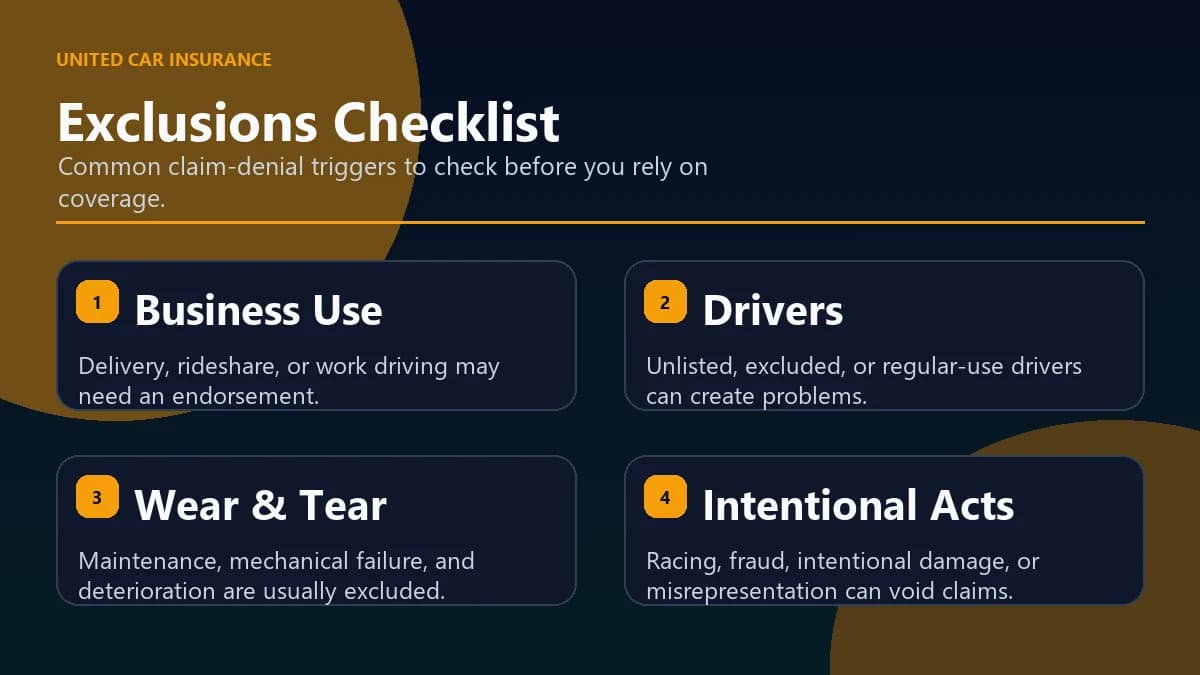
Exclusions are not random. They follow patterns: business use, intentional acts, wear and tear, custom parts, and excluded drivers. Find the ones that touch your life, grab the right endorsement, and save the proof.
Take 20 minutes today: open your policy, mark your exclusions, and email your agent for the exact endorsements and costs. Your next claim will be a “yes” instead of a surprise “no.” Want a guided walkthrough? Open our Understanding Your Policy pillar guide and tick off each exclusion as you read.
If a claim is denied for an exclusion: recovery steps
A denial is not always final. You can appeal if the exclusion was misapplied, or pivot to another coverage if it exists. Move fast and stay factual.
- Get the denial in writing. Ask for the exact exclusion citation and page number.
- Check for an endorsement you already have. Sometimes the adjuster misses it. Send the form number and a screenshot.
- Provide context. If they think it was business use but it wasn’t, provide a statement and any proof (e.g., personal errand, no delivery app active).
- Escalate once. Ask for a supervisor review. Stay calm, stick to facts.
- Learn and close the gap. If the exclusion truly applies, add the correct endorsement immediately so the next claim is covered.
Sample scripts for your agent
Rideshare/delivery: “I occasionally drive for DoorDash on weekends. Please add the rideshare/delivery endorsement. What’s the daily and total limit, and what does it cost?”
Custom parts: “I installed $4,000 in rims and audio. What custom equipment endorsement covers that full amount? Please send the form number and monthly cost.”
Excluded driver: “My college-age son will drive the car this summer. He’s currently excluded. What will it cost to add him for June–August, and can we remove the exclusion afterward?”
Rental/borrowed cars: “Do I have coverage when I rent? Is collision included? If not, should I buy the rental company’s waiver?”
State rules to check locally
Exclusion and endorsement rules can change by state. Before you rely on an assumption, check:
- Rideshare laws: Some states mandate specific coverages for TNC drivers. Confirm what your state requires.
- Teen driver rules: Some states require all household drivers to be listed; “excluded” may have strict definitions.
- Credit and telematics: A few states limit how insurers use credit or telematics data; ask if it affects exclusions or pricing.
Table: Real-world scenarios and fixes
Match your life to a scenario and apply the fix before you need it.
| Scenario | Exclusion risk | Fix |
|---|---|---|
| Weekend Uber/Lyft driver | No coverage while app is on | Add rideshare endorsement; confirm “Period 1” coverage |
| DIY contractor hauling tools | Business-use exclusion | Price a commercial auto policy with proper limits |
| Teen home for summer | Excluded driver uses car | Add teen temporarily; remove exclusion |
| Custom wheels + wrap | Custom equipment cap | Custom equipment endorsement equal to full value |
| Frequent rentals for work trips | Other vehicle/rental exclusion gaps | Confirm comp/collision extension; consider rental waiver |
One-page exclusion audit (do this now)
- Circle your life events: rideshare, delivery, teen driver, custom parts, rentals, business hauling.
- Open your policy PDF. Find “Exclusions” and “Endorsements.” Screenshot the pages.
- Email your agent: “I need coverage for [list]. Please send endorsement names, limits, and monthly cost.”
- Save their reply and the updated declarations page in one folder labeled “Auto-Exclusions-[Year].”
- Set a 6-month reminder to re-check when life changes (new job, new driver, new upgrades).
FAQ
If I add a rideshare endorsement, does it cover delivery? Often yes, but not always. Ask for delivery to be named in writing.
Do I need custom equipment coverage for a dash cam? Usually no. But wraps, rims, audio upgrades, lifts, and wheelchair lifts need it.
Does my policy cover me in a rental? Liability often extends; collision may not. Confirm and consider the rental company’s waiver if unsure.
What if my teen is excluded but drives anyway? You may have zero coverage for that accident. Add them before they drive.
Can exclusions change at renewal? Yes. Read renewal docs. Sometimes carriers tighten language; catch changes early.