
Search intent answer
diminished value claim
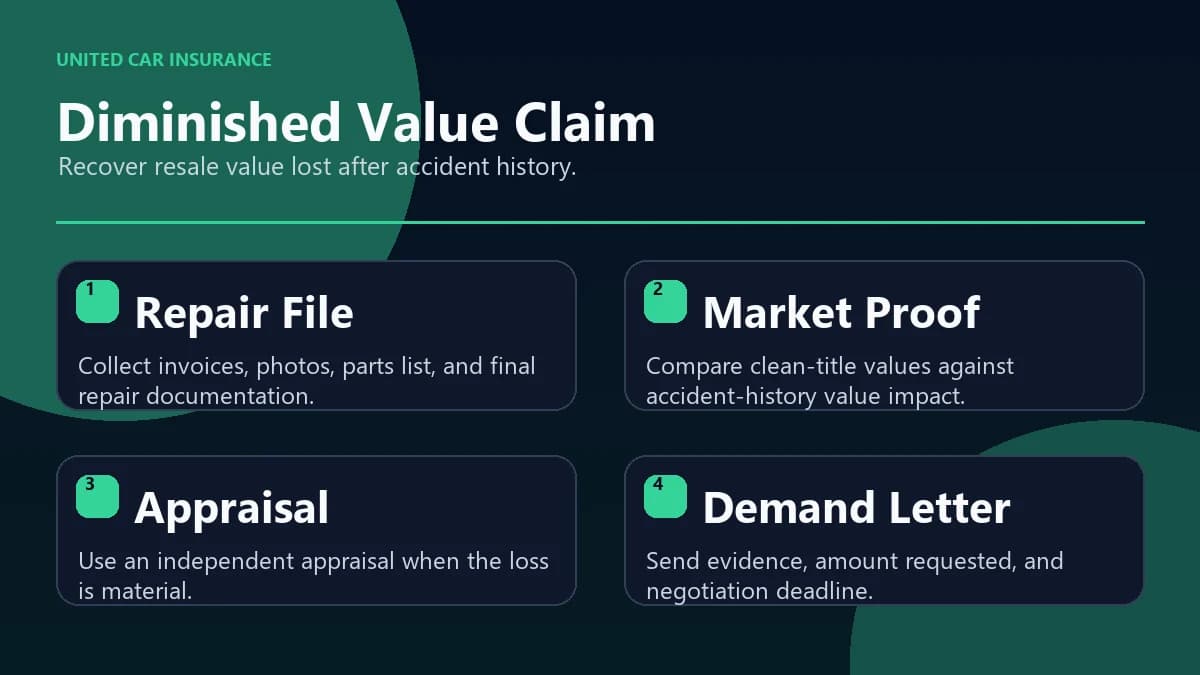
A diminished value claim asks for the market value your car lost because it now has an accident history. Most drivers pursue it against the at-fault driver’s insurer and support the demand with repair records, photos, comparable listings, and an appraisal.
Reader goal
Understand whether a diminished value claim is worth filing and what proof strengthens it.
What this page helps you decide
- Confirm whether the claim is first-party or third-party.
- Estimate value loss without relying only on the insurer’s 17c formula.
- Gather repair invoices, photos, vehicle history, and comparable listings.
- Prepare a demand letter and negotiation file.
Primary sources checked
- NAIC: Consumer Auto Insurance Guide
- NAIC: State Insurance Departments
- California Department of Insurance: Automobile Insurance Terms
A formula used by one insurer or court is not a nationwide rule. Preserve repair records, pre-loss condition evidence, comparable listings, and any independent appraisal.
Free internal toolkit
Build a documented claim file
Use checklists and templates to organize scene evidence, repair records, insurer contacts, and follow-up dates.
Open claim toolkitA properly repaired vehicle can still be worth less because buyers see an accident history. A diminished-value claim seeks that market loss, but eligibility and calculation vary by state, policy, fault, and evidence.
Three types of diminished value
Inherent
Market stigma remaining after proper repairs.
Repair-related
Loss tied to incomplete or substandard repairs.
Immediate
Difference between pre-loss value and value before repairs.
First-party versus third-party
A first-party claim is made under your own policy; a third-party claim is made against an at-fault party. Many policies restrict first-party diminished value, while state law may recognize some third-party claims. There is no reliable nationwide answer.
The 17c formula is not a nationwide law
Some claim handlers use a method commonly called 17c that starts with a percentage cap and applies damage and mileage factors. It arose from Georgia litigation and is not a universal statutory formula. Ask how the offer was calculated and compare it with market evidence.
Evidence that can support a claim
- Pre-loss photos, condition, mileage, options, and service history.
- Repair estimate, final invoice, measurements, scans, and calibrations.
- Vehicle-history report showing the accident entry.
- Comparable listings or dealer statements isolating accident history.
- An independent appraisal when potential recovery justifies its cost.
A practical filing process
- Finish repairs and document quality unless local procedure requires otherwise.
- Confirm liability and whether the claim is first- or third-party.
- Verify the state rule through the insurance department and statutes.
- Prepare a concise demand with vehicle, accident, repair, and valuation evidence.
- Ask for the insurer's calculation and respond to specific assumptions.
- Compare appraisal, complaint, negotiation, and legal costs with the dispute.
Do not assume an appraisal is mandatory, a free calculator is worthless, or filing suit forces settlement. Those choices depend on evidence, court limits, policy rights, deadlines, and expected value.
Verify local rules through your state insurance department.