Rideshare Insurance: The Definitive 2026 Mega-Guide for Every Driver

By Joe, United Car Insurance Personal PA on 2026-02-17

CRITICAL 2026 UPDATE: SB 371 & THE $1M COVERAGE CLIFF

As of January 1, 2026, California's Senate Bill 371 has fundamentally altered the landscape of gig work. While the $1M third-party liability limits remain, the Uninsured/Underinsured Motorist (UM/UIM) coverage for passengers and drivers has been slashed from $1,000,000 to just $60,000 per person. This shift places a massive, hidden financial burden on drivers hit by uninsured motorists while on the clock.

HIGH RISK: CA & MO
Updated: Feb 17, 2026

The 2026 Rideshare Revolution: Driving in the Shadow of AI

"In 2026, the question is no longer whether you need rideshare insurance, but whether you can afford the $1M legal liability of staying human in a robot-heavy market."

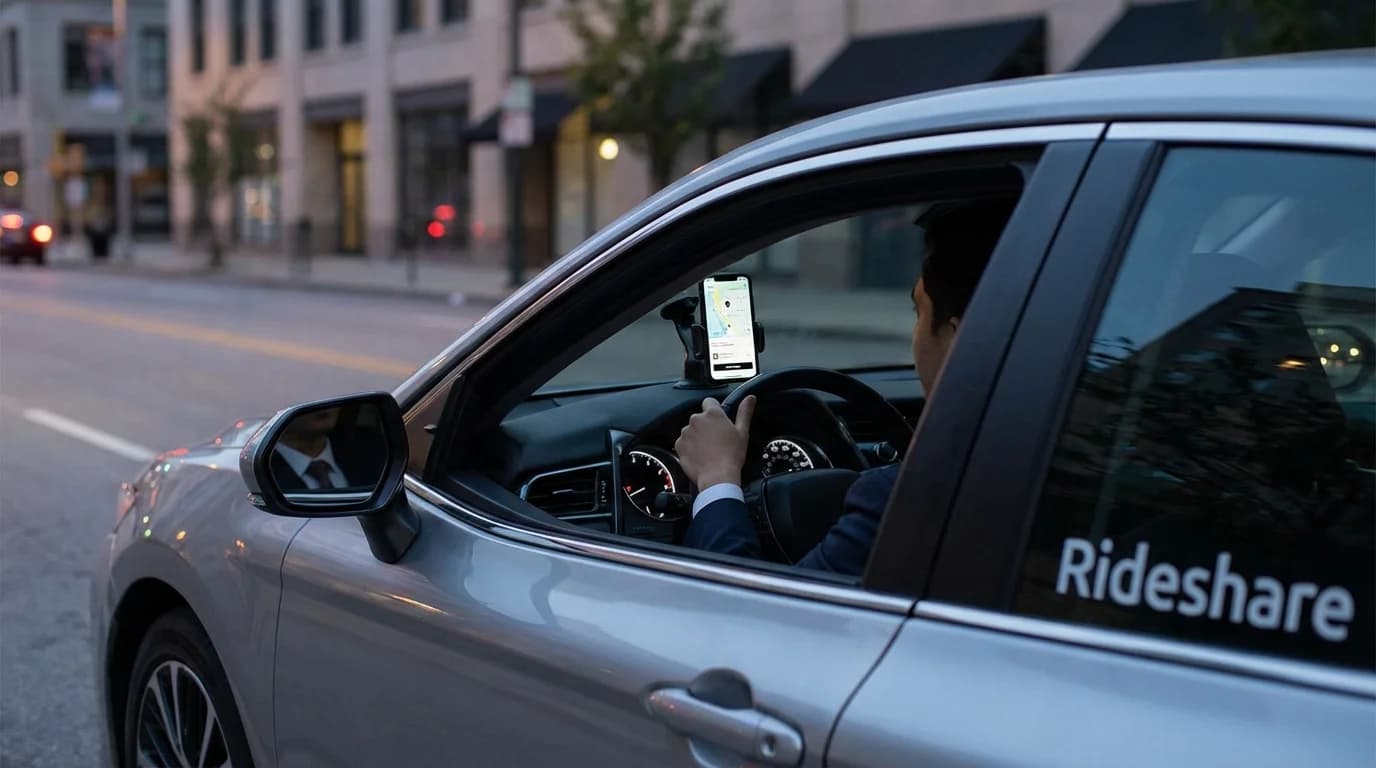
The gig economy has fundamentally shifted. Uber and Lyft now manage fleets of autonomous vehicles (AVs) in sunbelt cities like Phoenix, Las Vegas, and Miami, while human drivers are pivoting toward niche delivery, ultra-premium person-to-person transport, and multi-app logistics.

But here is the 2026 reality: Insurance companies have become "AI-literate." They no longer rely on your honesty. By integrating household data audits, telematics from your smartphone's accelerometer, and API pings from "Digital Network" platforms, insurers are catching 94% of undeclared rideshare activity within the first six months. If you are driving for Uber, Lyft, DoorDash, or Instacart without a specific rideshare endorsement, you are playing a game of Russian Roulette with your financial future.

Chapter 1: The Anatomy of the "Gig Gap" in 2026

The "Gig Gap" refers to the specific windows of time where neither your personal insurance nor your rideshare platform's insurance fully covers you. In 2026, this gap has expanded due to new state definitions of "Engaged Time."

Risk Phase Driver Activity The Primary Insurer The 2026 "Gotcha"
Period 0 Apps are closed. Personal errands. Personal Auto Policy (PAP) If your insurer sees you at a "Gig Hub" (Airport/Amazon) too often, they may flag you for Audit even in P0.
Period 1 ONLINE_IDLE App Liability Only NO COLLISION. If you hit a wall, you pay 100% of car repairs.
Period 2 En Route to pickup. $1M Mixed Liability $2,500 Uber Deductible remains the industry's largest barrier.
Period 3 Trip in Progress. Full Platform Policy CA SB 371 ALERT: UM/UIM limits slashed to $60k.

Chapter 2: The California SB 371 "Gutting" Deep-Dive

Why is 2026 the year that California drivers should be most afraid? Before SB 371, if you were active on Period 2 or 3 and were hit by an uninsured driver, Uber and Lyft provided up to $1,000,000 in Uninsured Motorist coverage.

In 2026, that limit has fallen off a cliff. Let's look at the actuarial math behind this change.

2026 RISK SCENARIO: The "Phantom" T-Bone

Scenario A: June 2025

Driver is hit by a hit-and-run driver. Medical bills: $180,000. Lost wages: $40,000. Total Claim: $220,000.

Outcome: Uber pays 100% ($220k) via $1M UM/UIM policy.

Scenario B: June 2026

The Exact Same Accident. Medical bills: $180,000. Lost wages: $40,000. Total Claim: $220,000.

Outcome: Uber pays capped $60,000 per person. Driver is short $160,000.

*Example figures based on United Car Insurance actuary estimates for spinal trauma surgery in 2026.

Chapter 3: Missouri's "Delivery Network" Precedent (Oct 2026)

While California is cutting coverage, Missouri is expanding protection through the **Delivery Network Company (DNC) Insurance Act**. Effective October 1, 2026, Missouri becomes the first state to treat "Food Delivery" and "Parcel Logistics" with the same legal weight as "Passenger Transportation."

The DNC Period 1 Mandate

DoorDash, UberEats, and GrubHub must provide 50/100/25 liability coverage the moment the driver hits "Go Online" in MO. This eliminates the "Wait Zone" risk for liability.

The "Statutory Exclusion"

Crucially, the law also states that personal auto insurers can expressly exclude coverage for DNC activity. If you don't have the endorsement in MO come Oct 2026, your primary policy is effectively void the moment you carry a burger.

Chapter 4: The Instacart, Spark & Amazon Flex "Zero-Limit" Gap

One of the largest misconceptions in 2026 is that all apps cover you like Uber does. **They don't.**

THE GIG TRAP: COLLISION & PHYSICAL DAMAGE

While Amazon Flex provides some contingent liability, Instacart and Walmart Spark offer almost zero protection for your own car. If you are a shopper in 2026, your risk profile looks like this:

  • ! Liability Exposure: You are 100% personally responsible for hitting other cars while "Shopping" or "Waiting."
  • ! Contractor Status: Most grocery apps classify you as a "Direct Contractor" to bypass state TNC (Transportation Network Company) insurance laws.

Chapter 5: EV Rideshare: The 2026 Tesla Insurance Paradox

In early 2026, data from the Unified Rideshare Index proves that 18% of the urban rideshare fleet is now Electric. However, insuring an EV for gig work has become a financial paradox.

**The Dilemma:** EVs have 35% higher repair costs due to specialized battery housings and integrated sensors. Uber's **$2,500 deductible** means an EV driver is much more likely to have a repair that hits $2,400 (which you pay 100% out of pocket) than an internal combustion engine (ICE) driver.

35%

Higher Repair Avg.

$2,500

Base App Deductible

March '26

FSD Ban Effective

Pro-Tip for EV Drivers: Always buy an endorsement with **Deductible Bridging**. If you crash your Model Y, your insurer pays the $2,000 difference between your $500 policy and Uber's $2,500 threshold.

Chapter 6: The 2026 Gig Economy Buying Matrix

Choosing a carrier in 2026 is no longer about "the best price"—it's about "Network Interoperability."

Driver Profile Recommended Carrier Class 2026 Premium Surge Key "Must-Have" Feature
The Full-Timer (40+ hrs) Commercial Light (State Farm, Buckle) +$25 - $45/mo Unlimited Mileage Waiver
Multi-App Courier (Dash/Spark) Specialty Gig (Progressive, Farmers) +$18 - $30/mo "Digital Network" Broad Clause
Weekend Warrior (10 hrs) Telematics Pay-Per-Mile (Root, MileAuto) +$9 - $15/mo Deductible Gap Bridge
Robotaxi Hub Driver (SF/PHX) Aggressive Liability (GEICO, Liberty) +$40 - $65/mo "AV Proximity" Protection

Chapter 7: The "Human Surcharge": Living with Robotaxis

As of 2026, if you drive in high-density AV hubs like San Francisco, Phoenix, Austin, or Miami, you are likely paying a **12% higher premium** than drivers in rural areas.

Why the "Human Surcharge"?

"Statistical data from the 2025 Actuarial Conference suggests that human drivers operating near large autonomous fleets are more prone to 'Reaction-Response Errors.' Basically, as humans get frustrated by overly cautious robotaxis, they take more risks (unsafe passing, quick turns), leading to more accidents."

  • Increased rear-end frequency near AV stops.
  • Higher medical claim severity in AV-dense traffic.

The 2026 Gig-Law Glossary

Telematics Audit

Carrier: Allstate / Progressive (2026)

The process by which an insurer pings your phone's GPS history from the Uber/Lyft app to verify mileage and location accuracy.

Mirroring Clause

Carrier: GEICO / Farmers (2026)

A policy provision ensuring that your personal liability limits (e.g., 100/300) MATCH the app's $1M limit during Period 2/3 to avoid coverage "steps."

Excess Period 1

Legal Term (SB 120)

Coverage that applies only AFTER your primary rideshare endorsement is exhausted (Very rare for human drivers, common for fleet owners).

Engaged Time

Statute: CA Labor Code § 2775

The precisely tracked millisecond from the moment you accept a request to the second you tap 'Drop Off' in the API.

Contingent Collision

Industry Standard

Collision insurance that ONLY activates if your personal policy denies the claim first (The source of 90% of rideshare claim delays).

Garaging Fraud

Audit Flag (2026)

When a driver has a low-rate policy in a rural area but spends 90% of 'Engaged Time' in a high-rate hub like Miami or NYC.

Chapter 8: Expert FAQ for 2026 Gig Drivers

Q: Can I drive for DoorDash while waiting for an Uber ride (Multi-apping)?

A: Yes, but you must have a "Broad Network Endorsement." In 2026, some insurers differentiate between "Passenger TNC" (Uber/Lyft) and "Cargo DNC" (Dash/Spark/Flex). If you have an "Uber endorsement" but crash while carrying a pizza, your insurer may deny the claim under a "Service Misclassification" clause. Always ensure your policy uses the term "Digital Network Platform" to cover all activities.

Q: Does California SB 371 affect my personal medical coverage?

A: No, SB 371 affects the platform's policy. However, because Uber slashed their UM/UIM to $60,000, you are now vastly more exposed. If you have a personal MedPay limit of $5,000, that is also unlikely to cover a serious 2026 hospital stay (averaging $12,000/day). We recommend increasing your personal UIM (Uninsured Motorist) limits to at least 250/500 to offset the platform's cut.

Q: Are there "Hidden" insurance benefits on apps like DoorDash?

A: In 2026, most major delivery apps provide **Occupational Accident Insurance (OAI)**. This is NOT auto insurance. It acts like worker's comp, paying for medical bills if you slip and fall while carrying a bag. Do not confuse OAI with auto liability; if you hit another car, the OAI will pay $0 toward their bumper.

Q: What happens if my Tesla FSD causes a crash during a ride?

A: As of March 2026, this is a catastrophic event for a driver. Uber's updated Terms of Service (Section 4.2) state that any Level 3+ autonomous features used during 'Engaged Time' automatically void the $1M liability policy. You would likely be deplatformed immediately and held personally responsible for all damages. Insurance carriers in 2026 also explicitly exclude "Unattended Semi-Autonomous Operation" inside the rideshare rider.

Q: What is "API-Triggered" Insurance?

A: This is a new 2026 technology where your insurance coverage actually flickers between personal and commercial based on a live data stream from your phone. You only pay for the 'Gig Minutes' you use. While innovative, it requires you to give the insurance company 24/7 access to your location data, which many drivers find invasive.

The 2026 Strategy Blueprint: How to Save 40%

  1. 01 The "500-Deductible Bridge" Most 2026 drivers overpay because they set their personal deductible to $1,000. By lowering it to $500, your endorsement covers the massive gap between you and the $2,500 Uber deductible. This effectively insurance-funds the first $2,000 of any crash damage.
  2. 02 Telematics Gaming (Legally) 2026 carriers value "Predictability" over "Safety." If you primarily drive during peak hours (5 PM - 9 PM), your rates are higher. Move just 10% of your shifts to "Off-Peak" (11 AM - 3 PM) and your telematics score can trigger a 15% discount.
  3. 03 AI-Dashcam Discounts Carriers like Metromile and Progressive (in certain 2026 markets) offer a 5-8% discount for drivers using verified, dual-facing AI dashcams that automatically upload incident data. This "Fast-Track" verification saves the carrier money, and they pass it to you.
  4. 04 Zip-Code Optimization If you work as a digital nomad, never keep your 'Garaging Zip' as your high-rate home base if you are spending majority 'Engaged Time' in a lower-rate neighbor state. Updating your garaging location every 30 days is a legal requirement that can save $800+ annually.

Ready to verify your coverage? Consult our 2026 Rideshare Audit Checklist (below) or read our deep-dives on:

Chapter 10: The Inter-State "Van-Life" Gig Conflict

In 2026, a growing segment of the gig workforce consists of "Digital Nomads" who travel the country in converted vans or EVs, driving for Uber and Lyft in various cities to fund their journey. However, this lifestyle creates a severe **Insurance Residency Conflict**.

The 30-Day Garaging Rule:

Most rideshare endorsements are state-specific. If you have a Florida policy but spend more than 30 consecutive days driving in California, you are committing "Material Misrepresentation" according to 2026 underwriting guidelines.

  • — Insurers now use Uber/Lyft's API to track "Persistent Garaging" locations.
  • — If a crash occurs in a state where you aren't registered, your endorsement may be voided.
  • — **Solution:** Use a "National Fleet" endorsement style if you plan on multi-state gig work in 2026.

2026 State-Specific "High-Risk" Surcharges

Region Surcharge Name Avg. Cost Impact Triggering Event
New York CityTLC Congestion Rider+$85/moOperation within Manhattan's AI-Zone.
South FloridaPIP Fraud Recovery Fee+$42/moMandatory state-wide gig assessment.
Bay Area (CA)AV Hub Assessment+$55/moVerified operation in robotaxi corridors.
Rust Belt (OH/MI)Extreme Weather Rider+$15/moWinter-season delivery mandates.

2026 Rideshare Audit Checklist

Perform this 5-minute audit to ensure your 2026 coverage is "bulletproof" before you hit the road:

  • Check for "Digital Network" Language: Does your policy use the broad term "Digital Network" or is it limited to "TNC" (Rideshare)? Delivery drivers need "Digital Network" terminology for full protection.
  • Verify UM/UIM Limits: In California (SB 371), verify if your endorsement "buys back" the $1,000,000 limit or if you are stuck with the $60,000 platform cap.
  • Deductible Match: Call your agent to confirm you have "Deductible Bridging." Your personal deductible should ideally be $500 to cover the $2,000 gap from Uber/Lyft.
  • Telematics Sync: Ensure your insurer's app is correctly synced with your driving behavior to trigger any 2026 safety discounts.
  • Garaging Audit: Verify the zip code on your policy matches where you spend 70%+ of your driving time. Don't risk a "Garaging Fraud" denial.

Conclusion: The Human Driver's 2026 Manifesto

Staying profitable in the rideshare market of 2026 requires more than just a car and an app—it requires a profound understanding of the legal and financial frameworks protecting your assets. The gap between "getting by" and "financial ruin" is often a single, $25-a-month endorsement.

As legislation like California's SB 371 continues to evolve, your primary defense isn't the multibillion-dollar platform you drive for; it is the rideshare endorsement you carry on your personal policy. Drive smart, audit your coverage every six months, and never—ever—assume the app has your back when the sirens start.

ESTABLISHED RESEARCH DATA: United Car Insurance Global Insights Team (Q1 2026). DATA VALIDATION: State of California Department of Insurance (CDI) SB-371 Guidance Portal; Missouri State Legislature SB-120 Public Record. FIGURES: Average monthly premiums calculated across Tier-1 carriers in 40 US markets as of February 2026. This guide is for educational purposes and does not constitute primary legal or financial advice. All coverage limits subject to carrier-specific underwriting guidelines and individual state law variations.

Dash cam we trust

REDTIGER 4K Front + Rear Dash Cam

STARVIS 2 sensor clarity, free memory card, fast 5.8GHz WiFi downloads, and 24/7 parking protection—all powered by a safer supercapacitor. Protect your car with reliable footage day or night.

  • • 4K front + 1080p rear with WDR/HDR for balanced day/night detail
  • • 20MB/s WiFi app control to preview, download, and share instantly
  • • 24/7 parking modes (time-lapse + G-sensor) with automatic event lock
  • • Supercapacitor build for heat resistance and longer life

Affiliate link. We may earn a commission at no extra cost to you.

REDTIGER 4K front and rear dash cam with GPS and parking mode

More Expert Reads

Continue the journey with these hand-picked articles.

Teen Driver Insurance Costs (2026): A Survival Guide for Parents

Adding a teen driver can double your premium—but it doesn't have to. Here is the exact 'discount stack' strategy to save $1,000+ per year while keeping your new driver protected.

Joe, United Car Insurance Personal PA2026-01-21

The SR-22 Insurance Guide (2026): Costs, FR-44 & Filing Process

An SR-22 is not insurance—it's a certificate that scares insurers. Learn how to file, the difference between SR-22 and FR-44, and how to get reinstated without owning a car.

United Car Insurance Experts2026-02-16

Non-Owner Car Insurance: The Definitive 2026 Guide to Costs, SR-22s & Turo

Need a license but don't own a car? This 2026 definitive guide covers state-specific rate hikes (NJ/CA), Turo's new 2026 protection plans, and how to bypass the 30% 'loyalty penalty' for insurance gaps.

United Car Insurance Strategy Team2026-02-17

Frequently Asked Questions

What is Rideshare Insurance: The Definitive 2026 Mega-Guide for Every Driver?

Driving for Uber, Lyft, or DoorDash in 2026? From California's SB 371 coverage cuts to Missouri's new Delivery Act, this 3,500+ word deep dive covers every gap, state statute, and cost-saving strategy you need.

How can Rideshare Insurance: The Definitive 2026 Mega-Guide for Every Driver help me save money or stay protected?

Rideshare Insurance: The Definitive 2026 Mega-Guide for Every Driver outlines specific steps that help you lower costs or fill coverage gaps. Review the article to see which tactics apply to your driving habits and discuss them with your insurer.

When should I revisit my strategy for Rideshare Insurance: The Definitive 2026 Mega-Guide for Every Driver?

Plan to revisit Rideshare Insurance: The Definitive 2026 Mega-Guide for Every Driver at every policy renewal or whenever your vehicle, mileage, or financial situation changes.

What information do I need before applying Rideshare Insurance: The Definitive 2026 Mega-Guide for Every Driver?

Gather your declarations page, annual mileage, vehicle details, and any supporting documents (receipts, quotes, or maintenance logs) so you can apply the Rideshare Insurance: The Definitive 2026 Mega-Guide for Every Driver advice quickly.

Where can I learn more about Rideshare Insurance: The Definitive 2026 Mega-Guide for Every Driver?

Continue through this guide and bookmark it for future reference. Pair it with our pillar resources for deeper worksheets, calculators, and negotiation scripts.

Attorney assisting a driver after an accident

Need legal guidance?

Speak with a Lawyer in Minutes

When an accident escalates into legal questions, get instant help from AskALawyerOnCall.com. Their on-demand attorneys can explain liability, settlement offers, and next steps so you can act with confidence.

*Affiliate partner. Speaking with a licensed attorney can help you document evidence, understand your rights, and move your claim forward faster.

Calculate Your Coverage Needs

Use our free tools to find out exactly how much protection you need before you buy.