The 2026 Reality Check
Buying an EV saves you money on gas, but it will likely cost you more on insurance. In 2026, EV premiums are averaging 23% to 49% higher than gas equivalents. This guide explains exactly why—and how to lower that bill legally.
Table of Contents
- 1. The 2026 Reality Check
- 2. Why is EV Insurance So Expensive?
- 3. Deep Dive: Battery Economics & Repair
- 4. Coverage Gaps: Chargers, Towing & Gap
- 5. The "Heavy Car" Problem: Liability Limits
- 6. Tesla & Rivian Insurance Programs
- 7. Telematics Showdown
- 8. State-Specific Rules
- 9. How to Lower Your Premium
- 10. Top Providers Watchlist
⚡ Key Takeaways
- • Premiums are higher: Expect to pay 20–50% more due to battery replacement costs ($5k+).
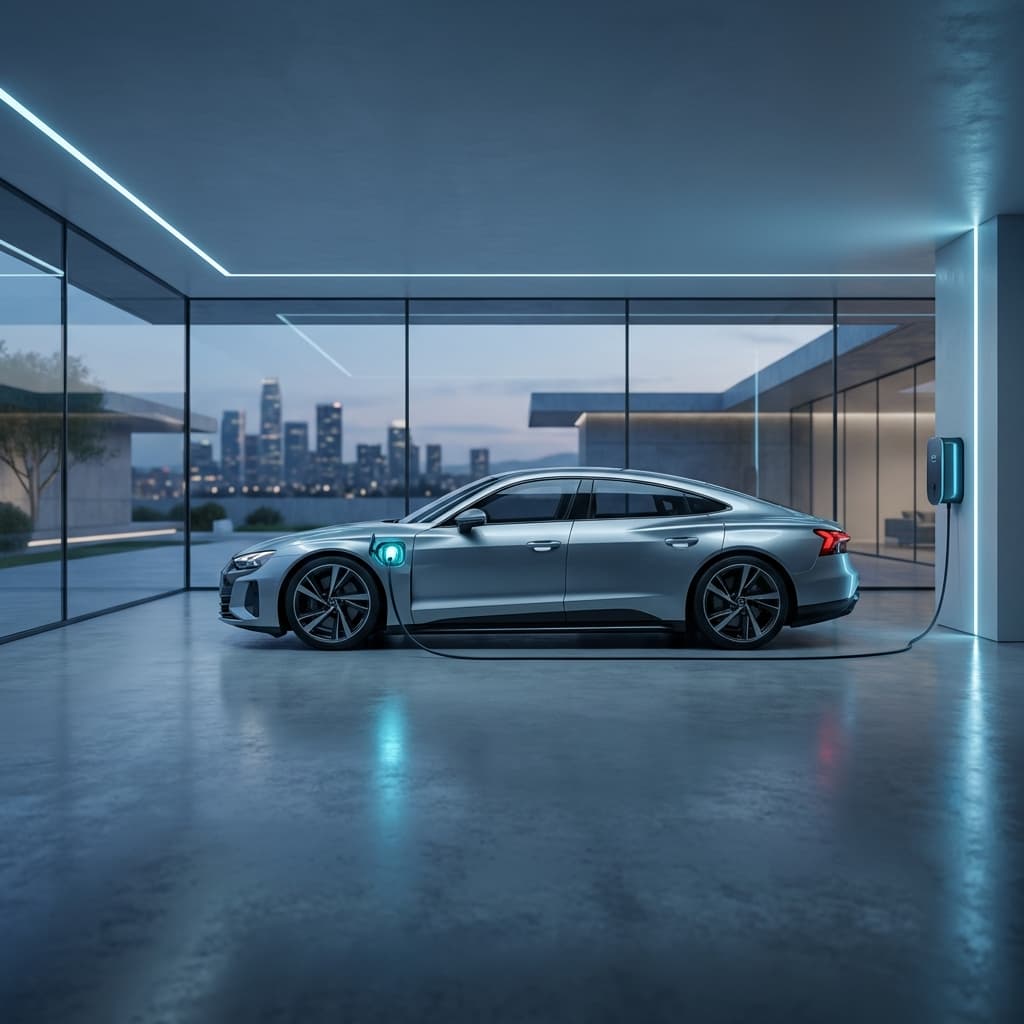
- • Check your gear: Ensure your home wallbox and charging cables are covered (often under Homeowners).
- • Towing rule #1: EVs require flatbed towing. Never tow with wheels on the ground.
- • Save smart: Ask for specific "green car" discounts and consider telematics for accurate pricing.
The silence of an electric motor is peaceful. The sticker shock of your renewal quote is not. Insurers are still adjusting to the "repair reality" of EVs. A fender bender in a gas car is a body shop visit. A fender bender in an EV can be a total loss if the battery case is scratched. Here is the raw data on costs, coverage gaps, and the smart moves to protect your Tesla, Rivian, or Bolt.
Why is EV insurance so expensive?
It is not a conspiracy; it is math. Insurers price risk based on what it costs to fix your car *today*, not what it might cost in ten years.
| Factor | The Cost Impact | Real-World Example |
|---|---|---|
| The Battery | Costs $5,000–$20,000 to replace | A minor undercarriage scrape can total the battery due to fire risk. |
| Specialized Labor | Requires high-voltage certified techs | Shops charge higher hourly rates; wait times are longer. |
| Parts Scarcity | OEM parts only (no cheap aftermarket) | Waiting 3 weeks for a bumper means 3 weeks of rental car costs for the insurer. |
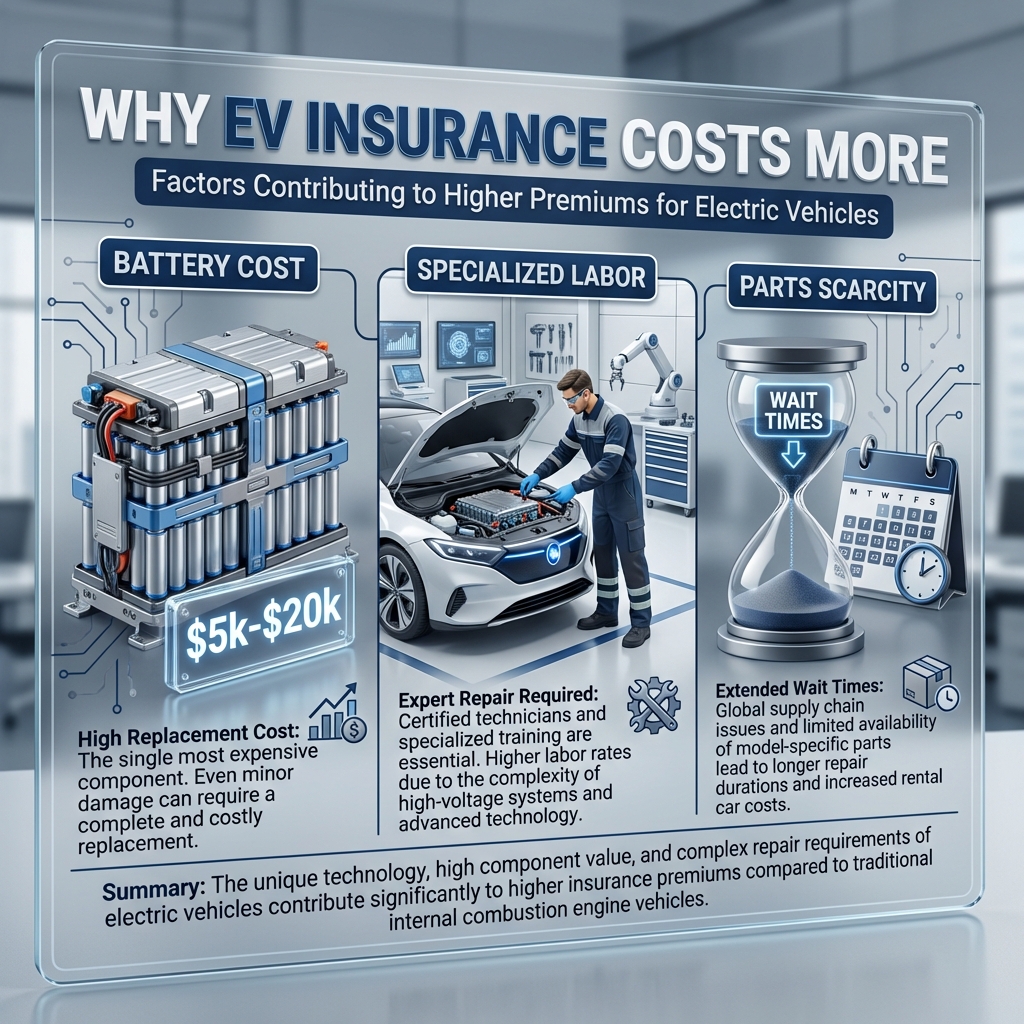
Visual breakdown of the primary cost drivers for Electric Vehicle premiums.
Deep Dive: Battery Economics & Repair
The battery pack is the single most critical component in your EV, representing 30-50% of the vehicle’s total value. For insurers, it represents a massive "total loss" risk.
The "Scrape" Problem
Most EV battery packs are located in the floorpan. In a gas car, running over road debris might dent an exhaust pipe ($200 fix). In an EV, if that debris dents the battery armor, insurers often must replace the entire pack ($15,000+) because they cannot verify if the internal cells were compromised. A compromised cell can lead to a thermal runaway (fire) days or weeks later. Insurers choose safety—and the total loss payout—over the risk of a house fire.
Repairability vs. Replacement: Legacy automakers (Ford, GM) are slowly making battery modules replaceable. However, many modern EVs use "structural packs" (bonded to the chassis) which are impossible to repair. If a structural pack is damaged, the car is often written off. This "disposable" nature drives up collision premiums significantly.
Coverage gaps: What your old policy misses
If you just swapped your Camry for a Model Y and kept the exact same policy, you might be exposed. EVs have unique hardware that standard policies overlook.
1. The Charging Cable & Wallbox
- Scenario: A thief steals your $500 charging cable, or a power surge fries your $1,200 wallbox.
- The Fix: Check if your policy covers "custom equipment" or "charging accessories." Often, a permanently installed wallbox is covered by Homeowners insurance, not Auto. A portable cord in the trunk is usually Auto (Comprehensive).
2. Towing Specifics
- Scenario: You run out of range (0% charge) on the highway.
- The Problem: Most EVs cannot be towed with wheels on the ground (it destroys the motor). You need a flatbed truck.
- The Fix: Ensure your Roadside Assistance explicitly covers "Trip Interruption due to charge depletion" and guarantees flatbed service.
3. Battery Degradation? No.
Myth: "My insurance will pay for a new battery if this one wears out."
Fact: No. Insurance covers sudden, accidental damage (crash, fire, flood).
Wear and tear (range loss) is a manufacturer warranty issue (usually 8 years/100k miles).
4. Gap Insurance is Non-Negotiable
EVs have historically seen volatile depreciation. Tesla price cuts in 2023/2024 caused used EV values to plummet. If you drag a 0% down payment loan for 72 months, you will likely be "underwater" (owe more than the car is worth) for years. Gap insurance pays the difference if your car is totaled. Without it, you could be making payments on a "dead" Tesla for two years after a crash.
The "Heavy Car" Problem: Why You Need Higher Limits
EVs are heavy. A GMC Hummer EV weighs 9,000 lbs. A Rivian R1T weighs 7,000 lbs. Even a Model Y is heavier than a comparable CR-V. Physics dictates that force = mass × acceleration. In a crash, your heavy EV will do significantly more damage to the other car than a gas sedan would.
Warning: State Minimums Are Not Enough
Many states (like CA) have property damage liability minimums as low as $5,000. If you rear-end a luxury car with your heavy EV, $5,000 won't even cover the bumper.
You could be sued for the rest.
Recommendation: For an EV, carry at least $100,000/$300,000 in Bodily Injury and $100,000 in Property Damage liability.
Manufacturer Insurance Programs: Tesla, Rivian, & More
Because legacy insurers were slow to adapt, some EV makers launched their own insurance products. These can be the "cheat code" to lower rates, but they come with trade-offs.
Tesla Insurance
Available in select states, Tesla Insurance uses "Real-Time Driving Behavior" to set your monthly rate. It tracks Forward Collision Warnings, Hard Braking, Aggressive Turning, Unsafe Following, and Forced Autopilot Disengagements.
- Pros: Often 20-30% cheaper than GEICO/Progressive for good drivers. No fees for "marketing" or "underwriting profit." Seamless claims handling via the App.
- Cons: Driving at night (after 10 PM) tanks your Safety Score. False Forward Collision Warnings can spike your premium. No bundle discounts for your home.
Rivian Insurance (with Nationwide/Cincinnati)
Rivian partners with major carriers to offer an "off-road capable" policy.
- Pros: Covers off-roading (which standard policies usually exclude). Includes accessories like the Camp Kitchen or Cargo Crossbars.
- Cons: Not a direct "in-house" underwriter like Tesla, so rates still depend on the partner carrier's logic.
Telematics Showdown: Tesla Safety Score vs. The Rest
If you drive an EV, you are already generating gigabytes of data. Using that data to lower your rate is the smartest financial move you can make. However, not all "spy" apps are created equal. Here is how the big players compare for EV drivers specifically.
| Program | Tracks Night Driving? | Max Discount | The "Gotcha" |
|---|---|---|---|
| Tesla Safety Score 2.0 | Yes (weighted heavily) | Variable (can be 40%+) | Driving past 10 PM creates a massive penalty. False FCWs (Forward Collision Warnings) can ruin your month. |
| State Farm Drive Safe & Save | No (mostly mileage/braking) | ~30% | Requires a Bluetooth beacon on the windshield. Good for night-shifters as it doesn't penalize night driving as harshly. |
| Progressive Snapshot | Yes | ~20% (avg) | Surcharge Risk: If you drive aggressively, your rate can actually go up. Tesla acceleration makes it easy to trigger "hard braking/acceleration" flags. |
State-Specific Rules & Rebates (2026)
Where you live dictates what you pay. Some states are pushing for EV adoption with insurance-specific rules, while others are adding registration fees to recoup gas taxes.
California
Ban on Gender/Credit: CA does not allow credit score or gender to factor into rates. This helps, but the high density of luxury EVs keeps repair labor rates astronomically high ($200+/hr).
New York
Photo Inspection: NY often requires a physical photo inspection for Comprehensive coverage to prevent fraud. Make sure to get this done within 14 days of buying your EV or coverage will lapse.
Florida
Flood Risk: After Hurricane Ian, many insurers exclude flood damage or charge a massive premium. For EVs, saltwater flooding is a death sentence for the battery. Ensure your Comprehensive deductible is affordable.
Texas
Hail Alley: Aluminum body panels on Teslas are expensive to perform paintless dent repair on. Comprehensive claims for hail are frequent.
You don't have to accept the 40% hike. Use the car's tech to your advantage.
Strategy 1: The "Green" Discount
Some carriers (like Travelers and Farmers) offer a specific discount (roughly 5%) just for owning a hybrid or electric vehicle. You often have to ask for it by name.
Strategy 2: Telematics is made for EVs
EV drivers tend to be smoother (regen braking encourages early slowing). If you drive like an EV pro, sign up for the safe driving program. Your natural driving style could earn you that 30% discount.
Strategy 3: Shop Specialist Carriers
Generic insurers might overprice EVs because they lack data. Look for carriers who "get" it. For Tesla owners, Tesla Insurance uses real-time driving data and often undercuts major carriers because they don't charge "marketing bloat" fees.
Top EV Insurance Providers (2026 Watchlist)
Based on recent user feedback and rate stability, these carriers are treating EV owners fairly:
| Carrier | Best For | Pros |
|---|---|---|
| State Farm | Bundling | Generally lower rate hikes for EVs than competitors. |
| Tesla Insurance | Tesla Owners | Rates based on YOUR driving, not regional averages. |
| Lemonade | Low Mileage | Offers specific "electric" add-ons for chargers. |
Bottom Line
EV insurance is more expensive, but it pays for catastrophic risks ($20k batteries) that gas cars don't have. Don't skimp on liability or comprehensive coverage just to save $20 a month.
Your Action Plan: Call your agent today and ask two questions: "Is my charging cable covered if stolen?" and "Does my roadside assistance include flatbed towing for EVs?" If the answer is "I don't know," it's time to switch. For more on switching without a headache, read our guide on comparing quotes correctly.